Balanced, or it does not post
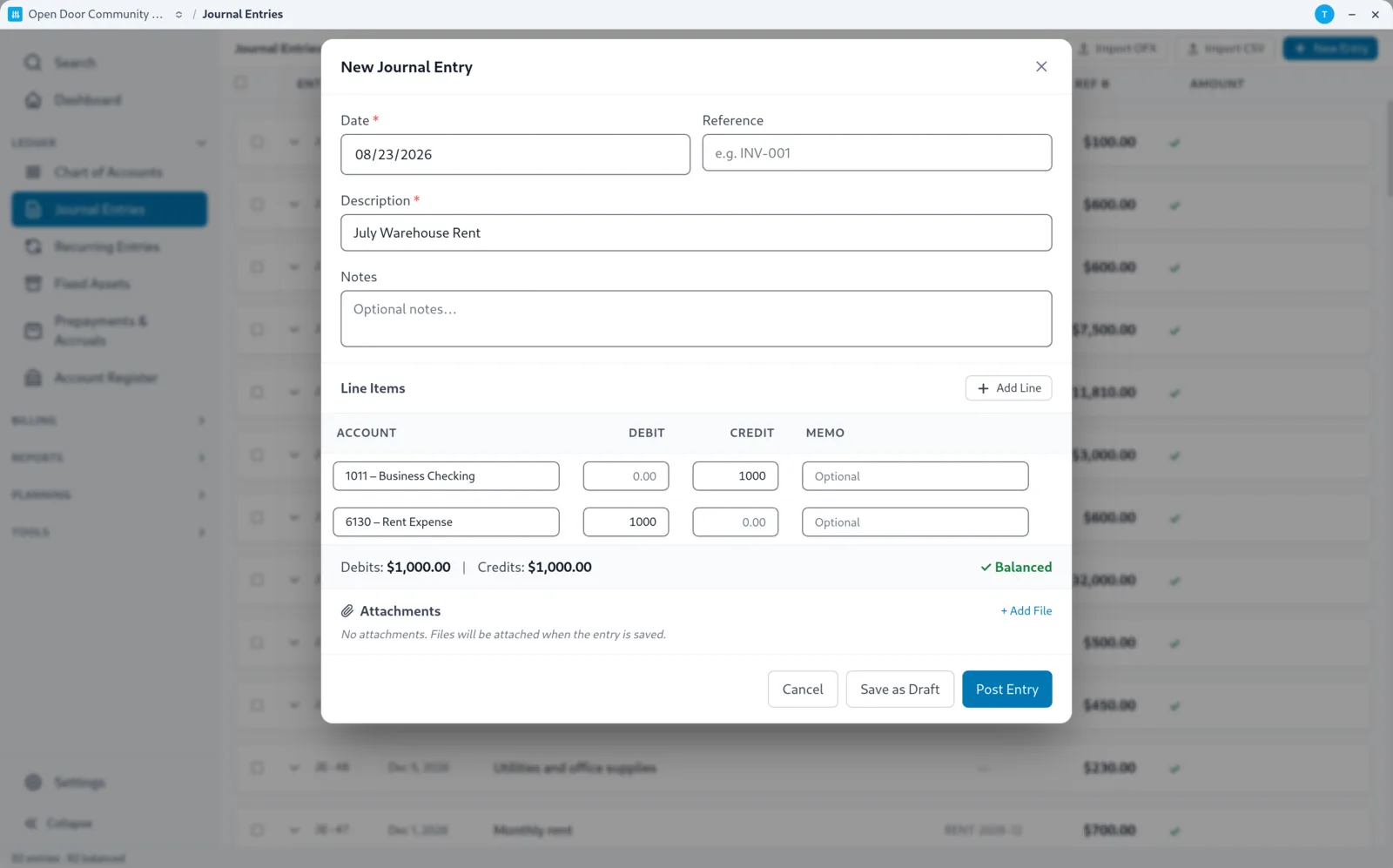
Debits equal credits, enforced at the database as well as in the application. Posted entries are voided with a reason rather than deleted, and entries are numbered in sequence so a gap is visible.


Ledger
For small businesses and non-profits that want their books in a file they hold, kept by software that behaves like an accountant would: balanced, evidenced, and readable years from now.
The application
What it does
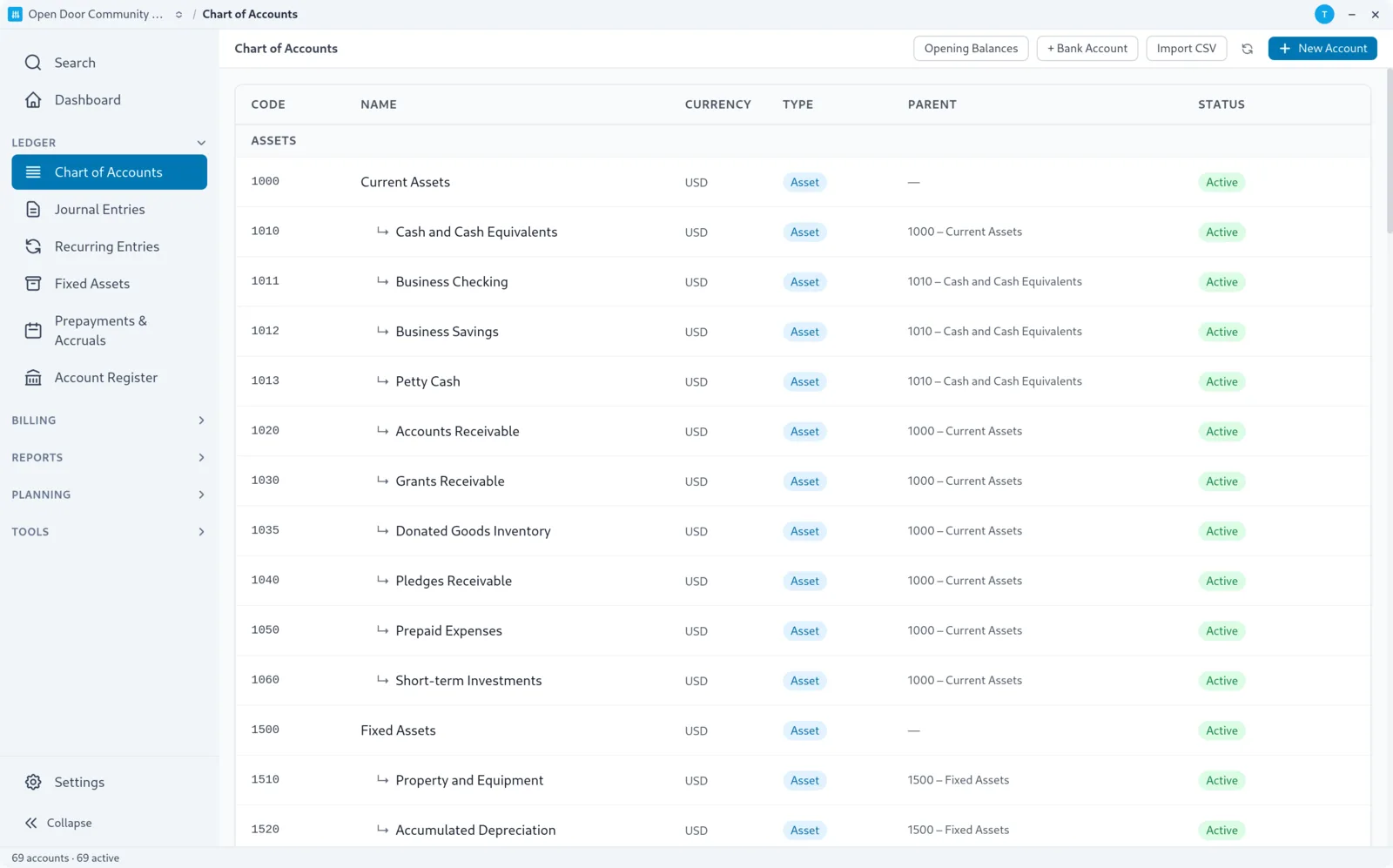
Not a simplified ledger that hides the accounting. The real thing, with the parts that make an audit survivable built in rather than bolted on.
Debits equal credits, enforced at the database as well as in the application. Posted entries are voided with a reason rather than deleted, and entries are numbered in sequence so a gap is visible.
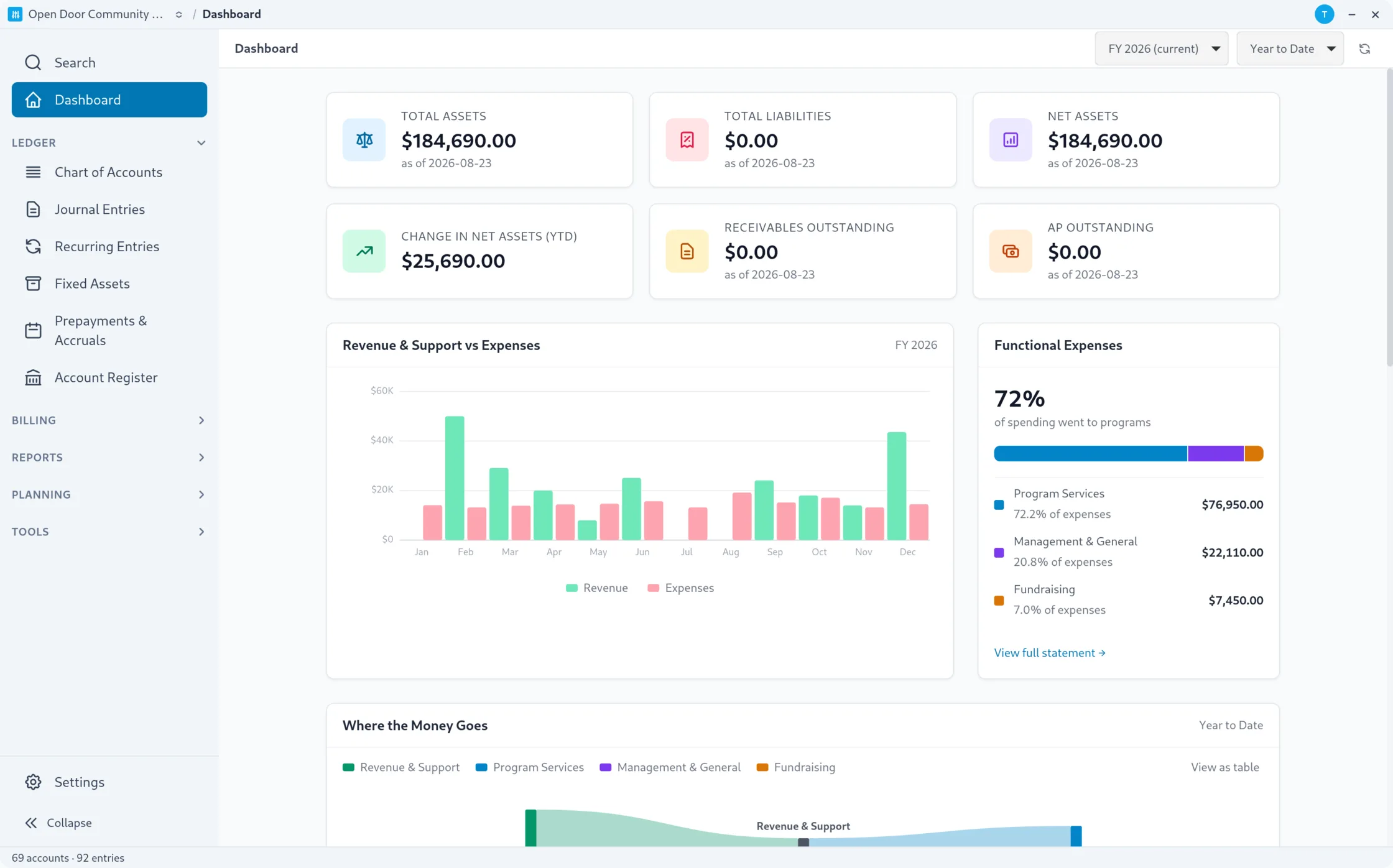
Raise an invoice and sending it posts the entry behind it. Record a payment in one click. Receivables and payables age into Current, 1–30, 31–60, 61–90 and 90+ so the awkward conversation happens on time.
Import OFX or QFX statements, let a rules engine map payees to accounts, and clear lines against the statement. Reconciliation completes only when the difference is zero, and cleared lines lock once it does.
Trial Balance, Balance Sheet, Profit & Loss and Cash Flow, each with a prior-period column and variance marked favourable or unfavourable. Click any figure to see the entries behind it. Export as CSV, ODS or PDF, or save a pack and export the lot.
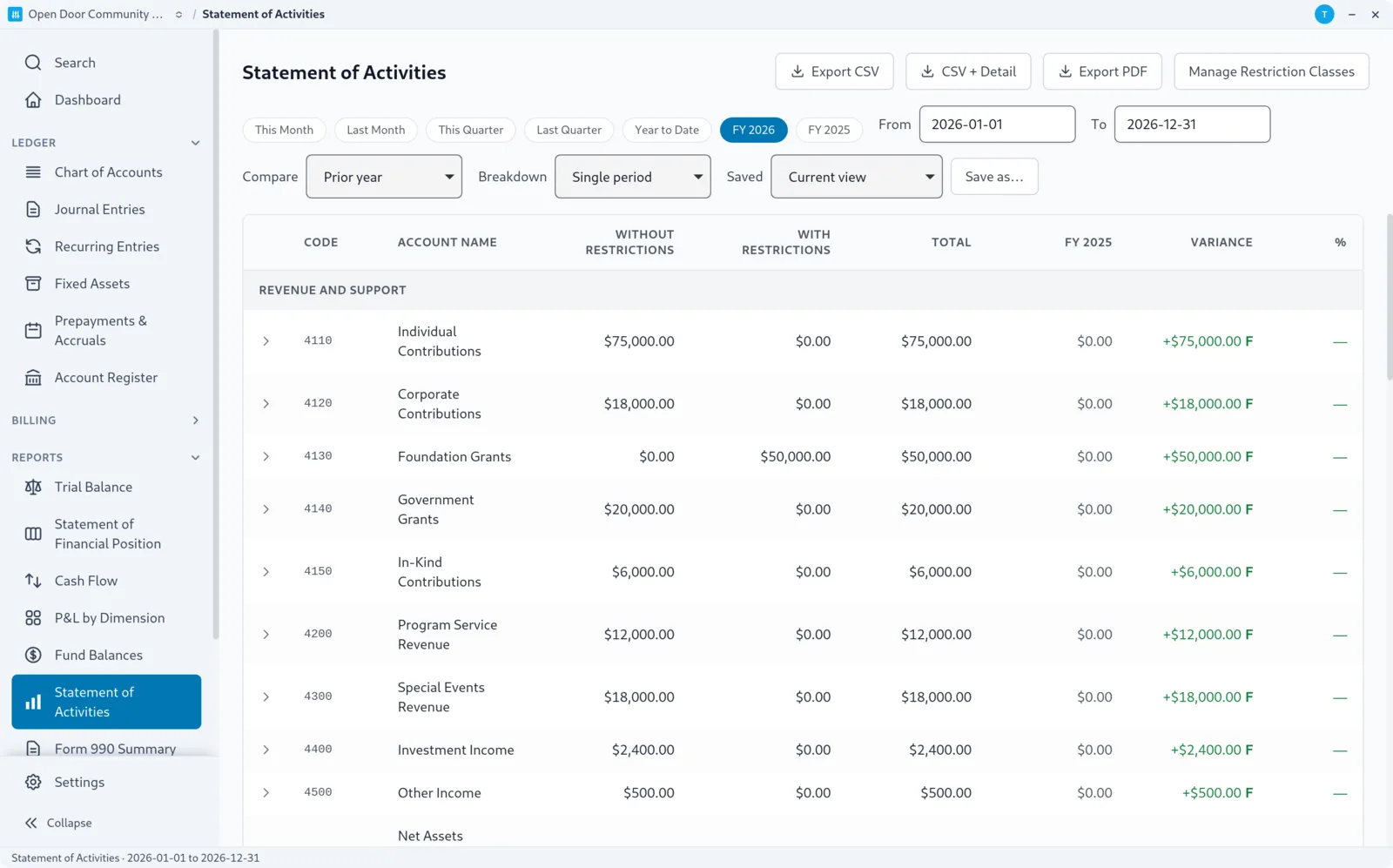
Switch the entity type and the reports follow: Statement of Financial Position, Statement of Activities with restricted and unrestricted funds, functional expenses laid out as Form 990 Part IX, and a 990 summary export.
A searchable audit log of every creation, edit and void. A lock date that closes a period against further changes. Receipts attached to the entry they belong to, stored in the company file so every backup contains them.
Ownership
Ledger is sold by subscription, so you are renting the software. You are not renting your records, and the difference is written into how the application behaves.
Your books are a SQLite database on your own disk. Copy it, back it up, put it on a drive in a safe.
If a subscription ends, every company still opens, every report still runs and every export still works. New entries stop; access to the old ones does not.
Cancel and you keep full access until the term you already paid for actually ends.
Plan limits gate writing, never reading. Every invoice, budget and report you already have stays visible and exportable on any plan.
CSV, ODS and PDF from every report, plus entry-level detail, so your data moves without us.
Backups cover attachments as well as the books, and a separate backup is taken before any upgrade rewrites the file.
Why it exists
We keep our own books, and the choices were a subscription that climbed every year or a spreadsheet that cannot enforce a balanced entry. Then one of us took a turn as treasurer on a non-profit board and hit the same wall from the other side: affordable tools assume you are a business, so the treasurer bridges the gap by hand every month and assembles a Form 990 at the end of the year.
So we built one application that does both properly, and we have closed our own books and the non-profit's in it ever since. Every feature on this page exists because a month end went badly without it.
How we build it
Ledger reports nothing back to us: no analytics, no usage tracking, no crash pings. We cannot sit behind a dashboard and infer what you need from click counts, so the only way anything gets built is somebody telling us.
Support email goes to the two of us. There is no tier one, no deflection and no bot in the way. Whoever replies can change the software, and often does.
We hit gaps in our own closes, but the sharpest ones come from somebody describing the month end that just went wrong. Tell us about yours and it shapes what ships next.
Every release is written in plain language: what changed, what was broken, and what it means for your next close. When we fix something that could have cost you data, we say so.
Ledger is our first product, not our last. If your business needs software that does not exist yet, that conversation is one we want to have.
Plans
Not by how many features we could think to withhold. Basic is the whole ledger. Pro is running a business on it. Team is more than one person in it.
or $50 a year · 1 seat
One person keeping a set of books on one machine.
or $100 a year · 1 seat
A business that bills people and does not want to lose its data.
or $200 a year · 3 seats
More than one person in the same books.
You pick your plan in the application. Install Ledger, create an account, and seven days of Pro start straight away. Choose and pay for a plan from Settings whenever you are ready, or let the trial end and carry on deciding.
Paying happens in your own browser. Checkout opens with our payment provider, in the browser you already use, with your password manager and an address bar you can check. Ledger never puts a frame around your card number.
Plan limits gate writing, not reading. Pages are never hidden and existing records are never locked away. On any plan you can open, read and export every invoice, budget and report in your books.
Get Ledger
There is no web signup: the application is what you install, and creating your account inside it is what starts the seven days of Pro.
Available now
DEB and RPM packages, published on every tagged release.
Ask for the Linux buildComing
Built from the same codebase; waiting on code signing and notarisation before it ships.
Tell me when it landsComing
An installer is produced by the same release build; not yet published.
Tell me when it landsContact
We build for small businesses and non-profits because we run one and keep the books for another. What customers tell us they need is what we build next, so if something is missing, or your business needs software that does not exist yet, we would like to hear about it.